





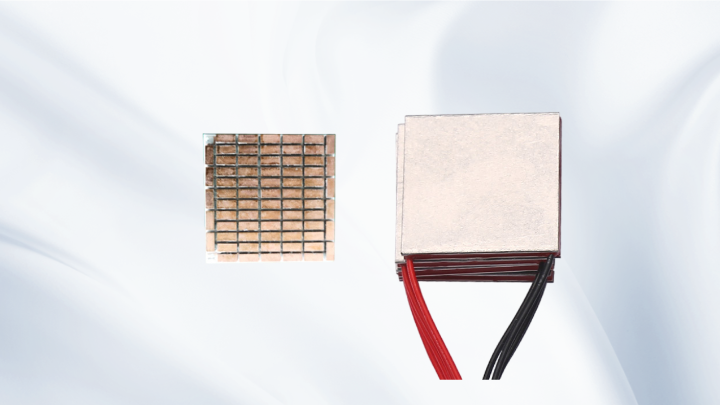
Thermoelectric Cooler Selection Guide: How to Choose the Right TEC Module
High-Quality Thermoelectric Cooler: A Technical Selection Guide
Selecting a thermoelectric cooler is not simply a matter of choosing a module with the highest Qmax or ΔTmax. The correct TEC depends on the actual heat load, required cold-side temperature, hot-side temperature, power supply, available space and hot-side heat dissipation.
This guide explains how to evaluate these parameters and select a TEC module based on the actual operating point rather than relying on maximum specifications alone.
What Should You Look for in a Thermoelectric Cooler?
A high-quality thermoelectric cooler is defined by its construction, material quality, and performance consistency. Semiconductor cooling relies on the Peltier effect, where a DC voltage applied across two dissimilar materials creates a temperature difference. The core components—bismuth telluride pellets, copper pads, and ceramic substrates—must be assembled with precision to ensure efficient heat transfer and long-term durability.
Quality distinctions often appear in the solder joint integrity, the uniformity of the pellets, and the flatness of the ceramic plates. A well-made TEC module will have a high cooling capacity (Qmax) relative to its size and a low thermal resistance between the ceramic surfaces. When comparing modules, look for detailed datasheets from reputable manufacturers like KKG. These specifications help you verify that the thermoelectric cooler meets the required thermal performance.
Key Performance Parameters: Qmax, ΔTmax, Imax, and Vmax
To select a high-quality thermoelectric cooler, you must understand the four fundamental parameters listed on every TEC datasheet:
- Qmax: The maximum heat absorbed at the cold side (in watts) when the temperature difference across the module is zero. This is the theoretical maximum cooling power.
- ΔTmax: The maximum temperature difference achievable between the hot and cold sides (in °C) when the heat load is zero. This is the highest temperature differential the module can produce under ideal conditions.
- Imax: The DC current that produces the maximum temperature difference, applied to the module operating at its rated voltage.
- Vmax: The DC voltage at which the module draws Imax and achieves ΔTmax.
It is crucial to recognize that Qmax and ΔTmax cannot be achieved simultaneously. In real operation, the actual cooling power and temperature difference depend on the heat load, the hot-side temperature, and the efficiency of the heat sink. A high-quality thermoelectric cooler will be specified with performance curves that show the relationship between Qc (cooling power), ΔT, and operating current. These curves allow you to predict the module's behavior under your actual conditions.
Selecting the Right TEC Module for Your Thermal Management Needs
Choosing the right Peltier module involves more than matching Qmax to your heat load. You must also consider the maximum temperature difference your application requires, the available power supply, and the physical dimensions. Here is a practical selection process:
- Determine the heat load: Calculate the total heat that must be absorbed from the object being cooled. Include active heat from electronic components, passive heat from the environment, and any heat generated by the thermoelectric cooler itself.
- Define the required temperature difference (ΔT): Establish the difference between the hot side temperature (often the ambient temperature plus the heatsink rise) and the desired cold side temperature.
- Select a module with appropriate Qmax and ΔTmax: Choose a TEC whose maximum values exceed your requirements by a safety margin. The TEC operating point should be selected from the manufacturer's performance curves according to the required cooling capacity, temperature difference, hot-side temperature and electrical conditions. Avoid treating a fixed percentage of Vmax or Imax as a universal operating rule.
- Check the performance curves: Use the datasheet graphs to verify that the module can deliver the required ΔT while pumping the calculated heat load.
- Match the electrical requirements: Ensure your power supply can provide the necessary voltage and current, and consider whether the module will be controlled by a thermostat or pulse-width modulation (PWM).
For high-temperature applications or where a large temperature difference is needed, multi-stage TEC modules may be required. These stack two or more Peltier coolers to increase the overall ΔTmax, but they have lower Qmax and higher power consumption. A high-quality thermoelectric cooler manufacturer will offer design guidance for these complex configurations.
The Role of Heat Sinks and Thermal Interface Materials
No matter how good the TEC module is, its performance is entirely dependent on the thermal management on the hot side. A thermoelectric cooler simply transfers heat from the cold side to the hot side; without an effective heat sink, the hot side temperature rises, which reduces the temperature difference and the cooling capacity. In fact, a poorly designed heat sink can turn a high-quality thermoelectric cooler into a low-performing component.
Use a heat sink with appropriate thermal resistance (usually expressed in °C/W). The lower the thermal resistance, the better the heat is dissipated. Also, apply a high-quality thermal interface material (TIM) between the TEC hot side and the heat sink, and between the cold side and the object being cooled. The TIM should be thin and uniform, as excessive thickness increases thermal resistance. Proper mounting pressure is also critical—too little pressure causes gaps, while too much pressure can damage the module.
For applications where the hot side temperature is particularly high, consider using a heat sink with a fan or liquid cooling. For sealed enclosures, the heat sink must dissipate all the heat from the TEC plus the heat drawn from the cold side. Always account for the total power input to the module when sizing the heat sink.
Common Applications and Engineering Considerations
A high-quality thermoelectric cooler is used across a wide range of industries. In medical devices, TECs maintain precise temperatures for diagnostics and sample storage. In telecommunications, they cool laser diodes and optical detectors. In industrial systems, they protect sensitive electronics in harsh environments. Each application presents unique challenges:
- Ambient temperature swings: If the hot side temperature varies, the TEC performance changes. A robust control system is necessary to maintain stable cold side temperature.
- Humidity and condensation: At temperatures below the dew point, condensation can form on the cold side. You may need to seal the TEC and provide moisture protection.
- Mechanical shock and vibration: Although TECs have no moving parts, they are fragile mechanically. Use shock-absorbing mountings and avoid excessive stress on the electrical leads.
- Power supply ripple: A clean DC power source is recommended. Voltage spikes can reduce the life of the module and cause performance fluctuations.
When these factors are managed correctly, a high-quality thermoelectric cooler can deliver reliable, maintenance-free operation for many thousands of hours. Partnering with an experienced manufacturer like KKG ensures you get a module designed for your specific conditions.
Frequently Asked Questions
Qmax is the maximum heat absorption when the temperature difference is zero, while ΔTmax is the maximum temperature difference when the heat load is zero. These are theoretical limits that occur under different conditions and cannot be achieved simultaneously.
Look for detailed datasheets with performance curves, tight manufacturing tolerances, and reliability testing data. Reputable manufacturers like KKG provide modules with consistent performance and long-term stability.
No. Exceeding the rated voltage can overheat the module, cause thermal runaway, and permanently damage the semiconductor pellets. Always operate within the specified ratings.
Yes, absolutely. A TEC without a heat sink will quickly overheat and lose all cooling capacity. The hot side must be effectively cooled for the module to function properly.
Estimate the total heat load, including heat generated by components, environmental heat gain, and the TEC's own power consumption. Then Select a TEC with sufficient cooling capacity at the actual operating point, including an appropriate engineering margin for heat-load variation, thermal losses and operating conditions. The required margin should be determined according to the specific application.
Conclusion
Choosing a high-quality thermoelectric cooler is a critical step in any thermal management project. By understanding the key parameters—Qmax, ΔTmax, Imax, and Vmax—and properly managing the hot side heat dissipation, you can ensure your Peltier cooler operates reliably and efficiently. Remember that performance is highly dependent on the complete thermal system, including heat sinks, thermal interface materials, and control electronics. Whether you need a standard TEC module or a custom solution, working with an experienced manufacturer like KKG provides the technical expertise and product quality necessary for success. Invest time in the selection process, and your application will benefit from stable, precise temperature control for years to come.1. What is the difference between Qmax and ΔTmax?2. How do I know if a thermoelectric cooler is high quality?3. Can I operate a TEC module at a voltage higher than Vmax?4. Do thermoelectric coolers require a heat sink?5. How do I calculate the required cooling capacity for my application?
