





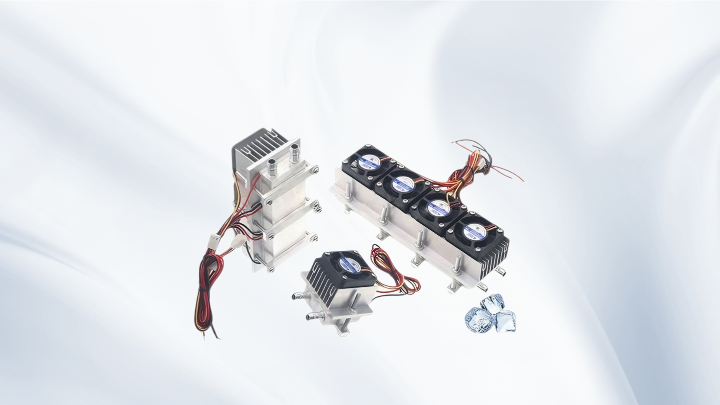
How to Select a Shenzhen Thermoelectric Cooler That Actually Fits Your Application
Shenzhen Thermoelectric Cooler: Understanding Its Working Principle
A Shenzhen Thermoelectric Cooler is a solid-state refrigeration component based on the Peltier effect. It is also commonly called a thermoelectric cooler, Peltier cooler, or TEC module. In simple terms, it is a semiconductor cooling device that transfers heat from one side of the module to the other when a DC voltage is applied. The side from which heat is pumped becomes the cold side, and the opposite side, which receives the heat, becomes the hot side.
Internally, a thermoelectric cooler uses two different semiconductor materials, usually bismuth telluride based p-type and n-type legs, connected electrically in series and thermally in parallel. These are sandwiched between ceramic substrates. When current flows through the junction, heat is absorbed on the cold side and released on the hot side. This makes a thermoelectric cooler an excellent choice for compact, precise, and maintenance-free thermal management.
Key Performance Parameters You Must Understand Before Buying
Choosing the right thermoelectric cooler from a Shenzhen Thermoelectric Cooler supplier starts with understanding its specifications. The four most important parameters on a TEC datasheet are Qmax, ΔTmax, Imax, and Vmax. Each of them is defined under strictly controlled laboratory conditions, usually at a hot-side temperature of 25°C or 50°C.
Qmax is the maximum heat pumping capacity, which occurs when the temperature difference between the hot and cold sides is zero (ΔT=0). ΔTmax is the maximum achievable temperature difference when no heat load is applied (Q=0). Imax is the current that produces this maximum temperature difference, and Vmax is the corresponding voltage under these conditions.
It is critical to understand that you cannot achieve Qmax and ΔTmax simultaneously under the same operating condition. A TEC module operates along a performance curve: as the temperature difference (ΔT) increases, the heat pumping capacity (Q) decreases linearly. Therefore, the actual cooling capacity of a Shenzhen Thermoelectric Cooler always depends on the thermal load, the hot-side temperature, the cold-side temperature, and the input electrical current.
How to Select the Right Shenzhen Thermoelectric Cooler Module
Selecting the correct module requires a systematic engineering approach. Many buyers simply pick the largest TEC they can fit, which often leads to poor efficiency or even overheating. The following steps will help you shortlist the appropriate thermoelectric cooler Peltier module for your application.
Step 1: Determine the Heat Load and Temperature Requirement
Start by calculating the total heat that must be removed from the cold side. This includes active heat from electronic components, as well as passive heat leaking from the environment through insulation, wiring, and mechanical supports. With that estimate, define the target cold-side temperature and the maximum acceptable hot-side temperature.
Step 2: Evaluate the Operating Conditions
Know your ambient temperature and the maximum hot-side temperature that your heat dissipation system can maintain. The performance of all TEC modules drops rapidly with increasing hot-side temperature. For example, a module that pumps 50 W with a 25°C hot side might only pump 40 W at 40°C. Always allow a safety margin and consider the thermal resistance of your heatsink and fan assembly.
Step 3: Compare Module Specifications Using a Performance Curve
Request the TEC module datasheet from the Shenzhen Thermoelectric Cooler manufacturer and look at the Q vs. ΔT curves at different electrical current levels. For your operating point, find which module can deliver the required cooling capacity at the required temperature difference. Choose a module that operates in the middle of its performance curve, not at its maximum values. This ensures stable operation and avoids running the module too close to its limits.
Step 4: Check Voltage and Current Compatibility
The input voltage and current of the module should be compatible with your power supply. Keep in mind that a thermoelectric cooler does not have a fixed resistance because it changes with temperature. At the same applied voltage, current increases when the hot side rises. It is essential to check the module's electrical resistance and its current requirement at your exact operating temperature, not just at 25°C.
Thermal Management: The Essential Partner of a Thermoelectric Cooler
Many people mistakenly think that a Shenzhen Thermoelectric Cooler works like a compressor-based cooler that blows cold air by itself. In reality, it simply moves heat from one side to the other. The hot side must be paired with adequate heat dissipation hardware such as a heatsink, fan, water block, or heat pipe assembly. If you fail to keep the hot side close to ambient temperature, the ΔT across the module increases, and the cooling capacity falls dramatically.
Heat dissipation is often the most underestimated part of a TEC system. The thermal resistance (Rth) of the hot-side heatsink and the case-to-heatsink mounting interface directly determine how much cooling power you get. To get the rated performance, use a thermal interface material (TIM) with appropriate conductivity and ensure smooth, clean contact between the TEC ceramic surface and the heatsink. Also, remember that all thermoelectric coolers need an active airflow or water flow on the hot side when the heat load is above a few watts.
Common Mistakes When Using a Peltier Cooler or TEC Module
Over the years, application engineers see the same issues again and again when a Peltier cooler is improperly installed or driven. The most common mistake is applying the rated voltage (Vmax) to the module without any heat load or with a very small heat load. This causes the cold side to get extremely cold, but the hot side may overheat, leading to condensation and a thermal runaway failure. Always drive the module with an appropriate current that matches your heat load and temperature requirement.
Another common mistake is using a heatsink that is too small. Since a thermoelectric cooler can pump more heat than a passive heatsink can dissipate, the hot side temperature rises, and the module operates outside its safe envelope. Additionally, many users forget to use a thermal fuse or a PID controller when precise temperature control is needed. A bare TEC module has no thermostat; without proper control, temperature can cycle or drift unexpectedly.
Why Location Matters: Sourcing a Shenzhen Thermoelectric Cooler from a Reputable Manufacturer
Shenzhen has become a global hub for thermoelectric cooler manufacturing and supply. When you search for a Shenzhen Thermoelectric Cooler, you will find many suppliers offering a wide range of TEC modules, Peltier coolers, and semiconductor cooling components. The main advantage of to sourcing from Shenzhen is supply chain speed and cost efficiency, but quality can vary significantly between factories.
If you are designing a product for industrial or medical use, work with a manufacturer that has comprehensive testing equipment and provides detailed performance datasheets. Look for a TEC manufacturer that can support you with custom module development, such as a high-temperature TEC, a miniature TEC, or a multi-stage TEC. A reliable partner will not only sell you a Peltier module but also help you select the right part and verify it under your conditions.
Frequently Asked Questions
Can I use a Shenzhen Thermoelectric Cooler without a heatsink?
No. Even at low power, a thermoelectric cooler transfers heat from the cold side to the hot side. Without a heatsink and fan to remove that heat, the hot side quickly overheats, and the TEC module may reach its maximum allowable temperature and fail. A heatsink is always required in a thermoelectric cooling system.
How do I know what voltage and current to apply to my TEC module?
Look at the datasheet curves provided by the manufacturer. The module's performance depends on the current, so calculate the necessary Q and ΔT. Use a power supply that can deliver the required current and adjust it gradually. Never simply apply Vmax unless the module is specifically designed for that condition.
What is the difference between Qmax and ΔTmax?
Qmax is the maximum heat that can be pumped when the temperature difference is zero. ΔTmax is the maximum temperature difference that can be created when the heat load is zero. Both are theoretical extremes and cannot happen simultaneously. In practice, the actual temperature difference and heat pumping capacity will always fall somewhere between these two values.
Can I adjust the temperature of a thermoelectric cooler?
Yes. By modulating the input current or voltage, the cooling power changes. For precise control, use a PID temperature controller with a thermistor or thermocouple as feedback. Reversing the polarity will invert the hot and cold sides, which is useful for heating applications.
How long does a thermoelectric cooler last?
TEC modules have no moving parts, so their life is generally limited by thermal cycling, humidity, and operating temperature. If kept within the recommended temperature range and properly sealed against condensation, a high-quality Peltier module can last more than 100,000 hours. But frequent thermal cycling can cause solder fatigue over time.
Conclusion
Selecting the right Shenzhen Thermoelectric Cooler is more than just reading a model number. You need to analyze your thermal load, design a proper hot-side heat dissipation system, and understand how temperature difference and input current interact. A well-chosen thermoelectric cooler can provide decades of maintenance-free solid-state cooling for laser systems, scientific instruments, medical devices, automotive electronics, and consumer products.
Work closely with your TEC supplier or manufacturer, share your real operating conditions, and ask for performance curves rather than relying solely on maximum specifications. With a systematic approach, a Shenzhen Thermoelectric Cooler can be a remarkably effective and reliable component in your thermal management solution.
Meta Title
Shenzhen Thermoelectric Cooler Selection Guide for Engineers
Meta Description
Learn how to select and apply a Shenzhen Thermoelectric Cooler for your thermal project. Understand Qmax, ΔTmax, and hot-side heat dissipation in this practical TEC module guide.
