





How to Select a Thermoelectric Cooler: A Practical Engineering Guide
What Is a Thermoelectric Cooler?
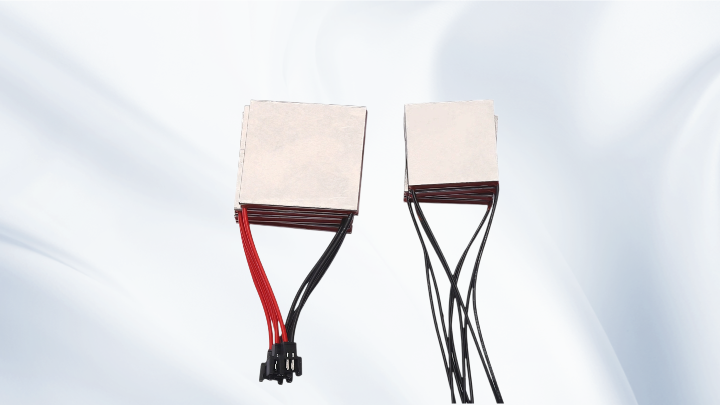
A thermoelectric cooler (TEC), also called a Peltier module, is a semiconductor-based device that transfers heat from one side of the module to the other when a DC current is applied. This solid-state cooling technology has no moving parts, making it highly reliable and silent. TEC modules are used in applications where precise temperature control, compact size, or spot cooling is required.
Key Performance Parameters of a Thermoelectric Cooler
To select a thermoelectric cooler effectively, you need to understand its datasheet parameters:
Qmax (Maximum Cooling Capacity)
Qmax is the maximum heat load a TEC can absorb from the cold side when the current is at Imax and the temperature difference between the hot and cold sides is zero (ΔT=0). It is measured in watts.
ΔTmax (Maximum Temperature Difference)
ΔTmax is the maximum temperature difference a TEC can achieve between its hot and cold sides when the heat load is zero (Qc=0). At this point, the module is running at its maximum current (Imax) and the cooling capacity drops to zero.
Imax and Vmax
Imax is the DC current that results in the maximum cooling capacity. Vmax is the corresponding voltage across the module at Imax and ΔTmax. Operating at Imax does not necessarily mean the highest coefficient of performance (COP); it is simply the point where Qmax is defined.
Other important parameters include the module's electrical resistance, maximum operating temperature, and physical dimensions.
Understanding the Relationship Between Qmax and ΔTmax
A common misconception is that a TEC can simultaneously deliver Qmax and ΔTmax. In reality, these are two extreme operating points. A thermoelectric cooler produces its maximum cooling capacity when the temperature difference is zero, and its maximum temperature difference when the cooling load is zero. In any practical application, the TEC operates somewhere between these extremes.
The actual cooling capacity (Qc) of a thermoelectric cooler depends on the temperature difference (ΔT) across it, the input current, and the hot-side temperature. As ΔT increases, Qc decreases. To achieve a large temperature difference, the TEC must run at a higher current, but this also increases the heat that must be rejected from the hot side. Understanding this trade-off is essential for proper system design.
Calculating Your Cooling Capacity Requirements
To select a thermoelectric cooler, you first need to estimate the total heat load your application must remove. This includes:
- Active heat load from electronics or other components
- Passive heat load from conduction, convection, and radiation
- The desired temperature difference between the cold side and the ambient environment
Once the total heat load (Q) and required ΔT are known, you can use TEC performance curves to select a module that provides sufficient cooling capacity at that specific operating point. Always choose a TEC with a Qmax that is 20–30% higher than your calculated heat load to account for losses and provide a safety margin.
The Critical Role of Hot-Side Heat Dissipation
The performance of a thermoelectric cooler is directly linked to how effectively heat is removed from its hot side. If the hot side becomes too hot, the temperature difference across the module increases, and its cooling capacity drops dramatically. A high-performance heatsink, fan, or liquid cooling system is essential to maintain a low hot-side temperature.
When calculating the required heatsink thermal resistance, you must consider both the heat pumped by the TEC (Qc) and the electrical power consumed by the module (Pin). The total heat that must be rejected from the hot side (Qh) is approximately Qc + Pin.
Practical TEC Selection and Integration Tips
Here are a few engineering guidelines to keep in mind:
- Always evaluate TEC performance curves under your specific hot-side temperature, not at standard datasheet conditions.
- Use a temperature controller to maintain stable operation and avoid thermal runaway.
- Apply thermal interface material (TIM) between the TEC, the cold plate, and the heatsink to minimize thermal resistance.
- For high-temperature difference applications, consider multi-stage TEC modules or cascaded arrangements.
- Protect the TEC from mechanical stress and humidity, as the modules are typically ceramic-based and can crack under excessive bending.
Frequently Asked Questions
1. How long does a thermoelectric cooler last?Thermoelectric coolers are solid-state devices with no moving parts, so their lifespan can exceed 100,000 hours of continuous operation when operated within specified ratings and with proper heat dissipation.
2. Can a thermoelectric cooler be used to both heat and cool?Yes. Reversing the polarity of the DC current changes the direction of heat flow. A TEC can heat or cool depending on the current direction, making it useful for precise temperature stabilization in optical systems and lab equipment.
3. What is the difference between a single-stage and a multi-stage TEC?A single-stage TEC typically provides a ΔTmax of about 60–70°C. A multi-stage TEC stacks several modules to achieve a larger temperature difference, often exceeding 100°C, but with lower cooling capacity and lower efficiency.
4. Why is my TEC not cooling as expected?Most TEC performance issues are caused by inadequate hot-side heat dissipation, low voltage or current, excessive thermal loads, or poor thermal interface contact. Check your system design and operating conditions to identify the root cause.
Conclusion
Selecting the right thermoelectric cooler requires a holistic approach that goes beyond simply matching Qmax and ΔTmax. You must account for your actual heat load, required temperature difference, hot-side thermal resistance, and operating environment. By understanding the fundamental parameters and their trade-offs, engineers can design reliable and efficient TEC-based thermal management systems.
Meta Title: How to Select a Thermoelectric Cooler: A Practical Engineering Guide
Meta Description: Learn how to select the right thermoelectric cooler for your application. Understand Qmax, ΔTmax, heat dissipation, and key engineering considerations in this practical guide.
