


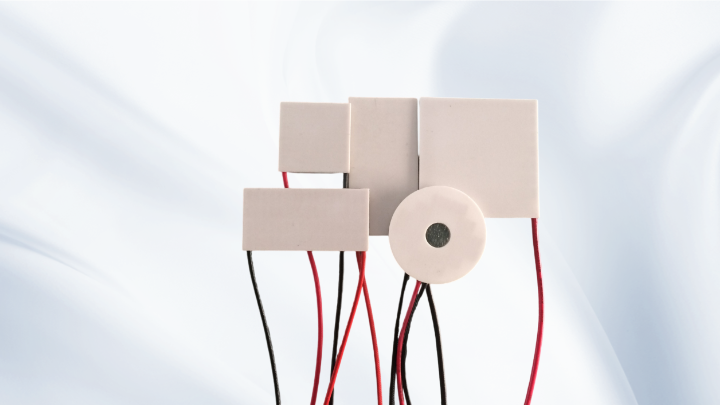
Thermoelectric Cooler Selection Guide: From Qmax and ΔTmax to Real System Design
Why Engineers Choose a Thermoelectric Cooler — and Where Its Limits Are
A Thermoelectric Cooler is a solid-state heat pump built from an array of p-type and n-type semiconductor pellets sandwiched between two ceramic substrates. When DC current flows through the module, charge carriers absorb heat at one junction and release it at the other, producing a cold side and a hot side. Reverse the polarity and the two sides swap roles, so the same device can heat as well as cool. This is why the terms Peltier cooler, Peltier module, TEC module, and semiconductor cooling device all describe the same family of components.
Because there are no moving parts, no refrigerant, and no compressor, thermoelectric cooling offers properties that mechanical cooling cannot easily match: silent operation, compact size, fast response, orientation independence, and the ability to hold a set point within a fraction of a degree. The trade-off is efficiency. A Peltier module generally runs at a lower coefficient of performance (COP) than a vapor-compression system, so it is most attractive when size, precision, or reliability matter more than power consumption.
One principle governs every design decision that follows: a thermoelectric cooler does not eliminate heat, it moves it. The heat pumped from the cold side plus the electrical power consumed by the module must both be removed from the hot side. If that heat is not carried away effectively, the hot-side temperature climbs, the usable temperature difference collapses, and the system looks like it has failed even though the module is behaving exactly as its datasheet predicts.
Reading Thermoelectric Cooler Datasheet Parameters Correctly
Manufacturer datasheets describe a module with a small set of headline numbers. Understanding what each one means — and what it does not mean — prevents most design mistakes.
Qmax, ΔTmax, Imax, and Vmax
Qmax is the maximum heat pumping capacity, reached when the temperature difference between the cold side and hot side is zero. ΔTmax is the largest temperature difference a module can produce, and it occurs when the heat load is zero. Imax and Vmax are the current and voltage at which those reference points are reached. Datasheets also list electrical AC resistance, which partly determines how much Joule heating the module generates internally.
The single most misunderstood point in thermoelectric cooling is that Qmax and ΔTmax are not achieved at the same time. They sit at opposite ends of the same performance curve. Between them lies every realistic operating point, where the module pumps less than Qmax while holding a ΔT smaller than ΔTmax. A selection that assumes both values simultaneously will always disappoint.
Everything Scales with Hot-Side Temperature
Datasheet values are normally referenced to a hot-side temperature of 27 °C. If your application runs the hot side at 50 °C, the achievable ΔT, the cooling capacity, and the power draw all shift. Ask for performance curves at your actual hot-side temperature rather than extrapolating from the reference table. Cold-side temperature, hot-side temperature, and ambient conditions — not the module alone — define real performance.
A Practical Thermoelectric Cooler Selection Workflow
Choosing a module is a system exercise. Work through the following steps in order; skipping one usually means repeating the process later.
Step 1 — Define the Total Heat Load
Add up everything the cold side must remove: the active heat from the device or sample, parasitic heat leaking in through insulation, wiring, and mounting hardware, plus any transient load during cool-down or pulsing. A sensor enclosure with poor insulation can leak more heat than the electronics generate. Underestimating the heat load is the most common cause of undersized cooling.
Step 2 — Set the Temperature Targets
Write down three numbers: the required cold-side temperature, the acceptable hot-side temperature, and the ambient temperature the heat sink will see. The gap between cold side and hot side is the ΔT your module must hold under load — not the ΔTmax printed on the datasheet.
Step 3 — Check Feasibility Before Buying
As a working rule, plan to operate at roughly 30 % to 50 % of Qmax and about 40 % to 60 % of ΔTmax. Operation closer to the limits is possible, but COP falls sharply, power consumption rises, and the system becomes very sensitive to heat sink performance and thermal resistance.
Step 4 — Budget the Heat Dissipation Path
The hot side must reject the heat load plus the module's electrical input. Estimate the thermal resistance from module hot side to ambient, including the thermal interface material, the heat sink, and any fan or ducting. If the required hot-side temperature cannot be reached with the available heat sink and airflow, no module choice will fix it.
Step 5 — Choose the Operating Point and Module Count
Using performance curves at your real hot-side temperature, find the voltage and current that deliver the needed cooling capacity at the required ΔT. From there, decide whether one module, several modules mounted on a shared plate, or a multi-stage stack is the better fit. Multi-stage TEC assemblies trade cooling capacity for a larger achievable temperature difference.
Step 6 — Verify Power Consumption and COP
Multiply operating voltage by current to get the module's electrical input, then add it to the heat load to size the heat sink. Check the resulting COP against your power budget. For battery-powered or sealed enclosures, this step often decides whether thermoelectric cooling is viable at all.
Heat Dissipation: The Real Limit in Most Thermoelectric Cooler Systems
Most complaints about weak cooling trace back to heat removal, not to the module. The hot side is the bottleneck, and it deserves to be treated as the primary design task rather than an afterthought.
Practical measures include choosing a heat sink rated comfortably below the required thermal resistance, applying a thin and even layer of thermal interface material, and controlling mounting pressure because ceramic substrates are brittle. Keep fins clear and match airflow to the actual enclosure, remembering that air inside a sealed cabinet is often noticeably warmer than room temperature. Where the cold side drops below the local dew point, moisture will collect, so sealing, conformal coating, desiccant, or a dry environment may be necessary to protect both the assembly and nearby electronics.
Matching the Module Type to the Application
Single-stage modules cover the majority of applications: instrument enclosures, laser and sensor cooling, sample holders, and compact electronics thermal management. Multi-stage modules stack several stages to reach a larger temperature difference at a lower heat load. Miniature TEC modules serve optical components, image sensors, and handheld instruments where space is measured in millimeters. High-temperature TEC modules use materials and solder systems suited to hot-side temperatures well above the standard range, which matters in automotive, industrial, and analytical equipment. Custom TEC assemblies — with defined footprints, lead configurations, sealing, or integrated temperature sensing — are common when a standard footprint does not fit the mechanical envelope.
Troubleshooting Common Thermoelectric Cooler Problems
Cold side is not cold enough. Usually the heat load is higher than assumed or the heat sink is undersized. Measure the hot-side temperature under load; if it sits far above target, correct the heat dissipation path first.
The module draws more current than expected. Check the actual applied voltage, wire gauge and connector losses, and whether the hot side is running hot, since electrical resistance increases with temperature.
Cooling performance degrades over time. Look for dried-out or contaminated thermal interface material, loosened mounting hardware, dust-blocked fins, or moisture ingress in condensing environments.
Module cracked or shorted. This is almost always mechanical: uneven clamping, over-torqued screws, thermal cycling stress, or a flatness mismatch between the module and the heat sink or cold plate.
Frequently Asked Questions
Can a thermoelectric cooler reach the ΔTmax shown on the datasheet?
Only at zero heat load and with an ideal hot-side condition. Any real heat load reduces the achievable temperature difference, which is why design targets should stay well inside the datasheet limits.
How do I know whether I need one module or several?
Divide the total heat load by the capacity each module can deliver at your required ΔT and hot-side temperature, then add margin. Several modules on a shared cold plate and heat sink often outperform a single large module in temperature uniformity.
Does a bigger module always cool better?
No. A larger module pumps more heat but also consumes more power and demands more heat dissipation. If the heat sink cannot reject the extra heat, a larger module can leave the cold side warmer, not colder.
Can I run a thermoelectric cooler at a lower voltage to save power?
Lower voltage reduces current and power, but it also reduces cooling capacity and the achievable ΔT. The better approach is to choose a module whose rated operating point matches your requirement instead of throttling an oversized one.
What maintenance does a TEC system need?
Very little mechanically, but the thermal path needs attention: keep the heat sink and fan clean, verify mounting pressure periodically, and replace thermal interface material if performance drifts.
Conclusion
Selecting a Thermoelectric Cooler is a system-level task, not a catalog lookup. Start with a realistic heat load, define cold-side and hot-side temperatures, and treat heat dissipation as the constraint that shapes every other decision. Read the datasheet knowing that Qmax and ΔTmax belong to different operating points, and that published values shift with hot-side temperature. When those fundamentals are respected, a Peltier module delivers precise, quiet, and reliable temperature control — and when they are ignored, no amount of additional cooling capacity will compensate.
META TITLE: Thermoelectric Cooler Selection: Qmax, ΔTmax, Heat Load
META DESCRIPTION: Learn how to select a Thermoelectric Cooler using Qmax, ΔTmax, heat load, and heat dissipation data, plus practical thermal management tips.
