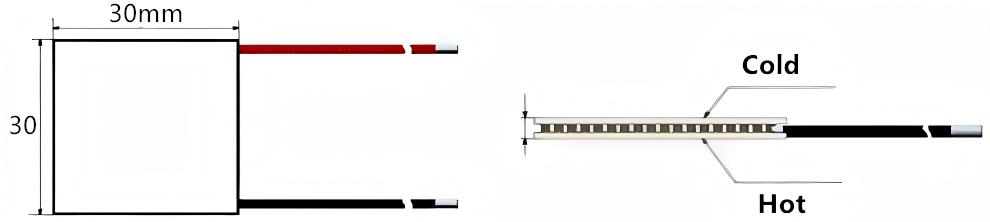
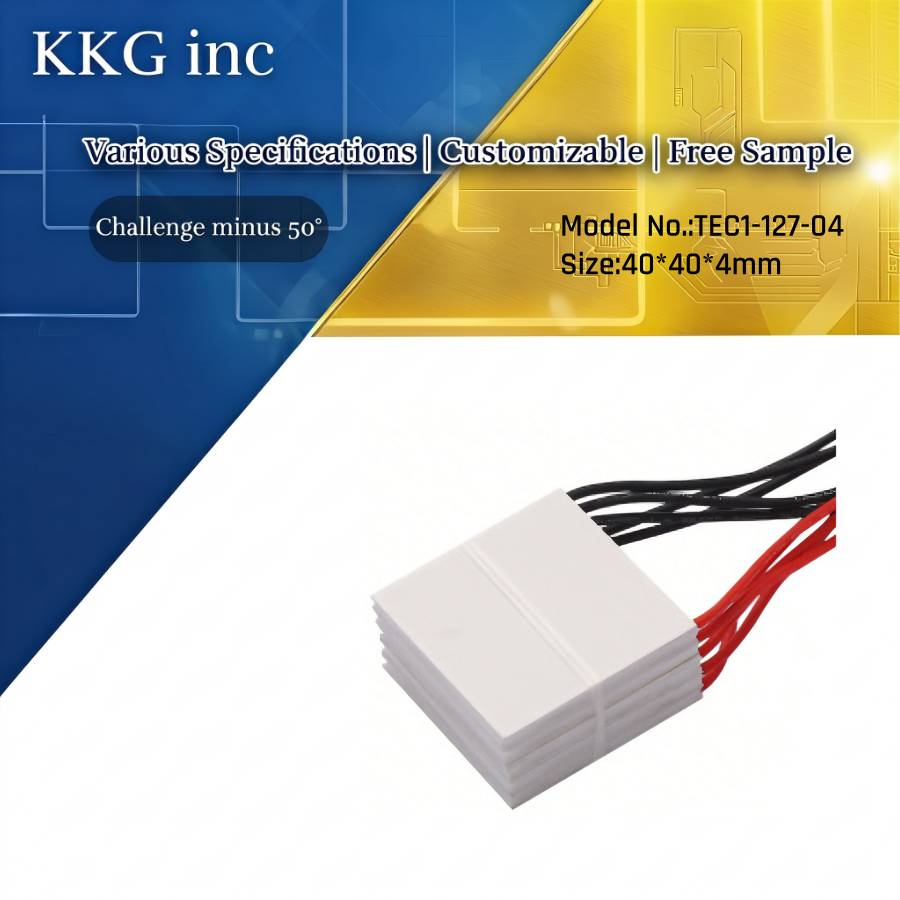
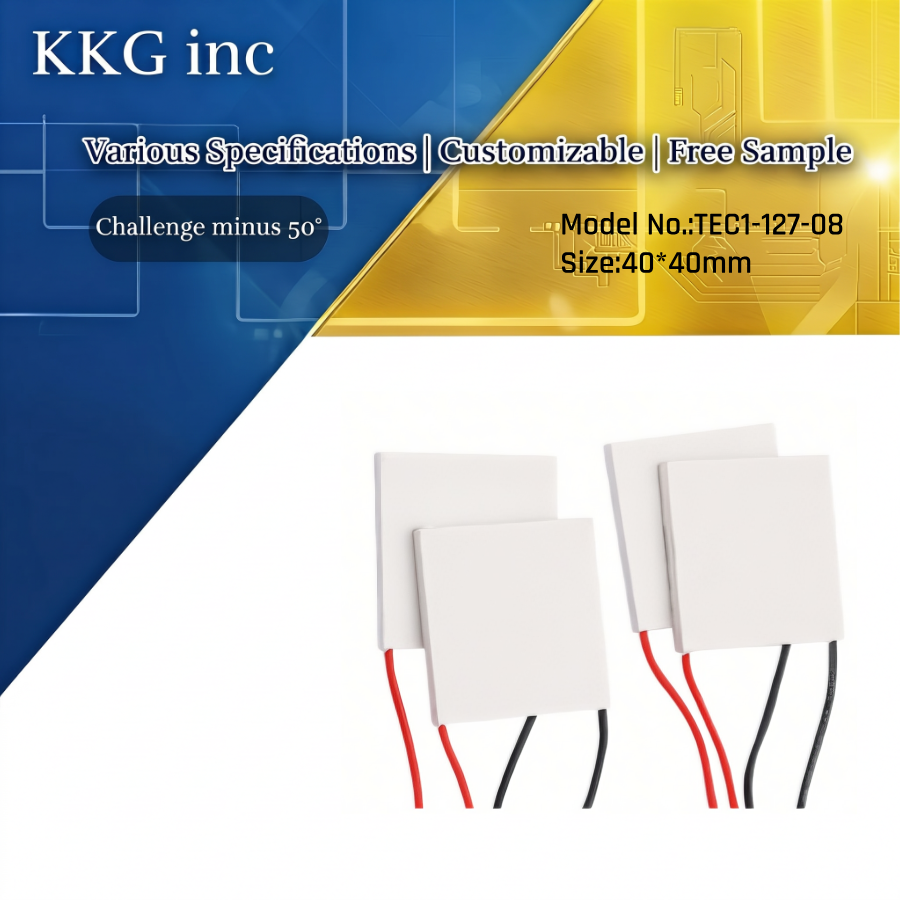
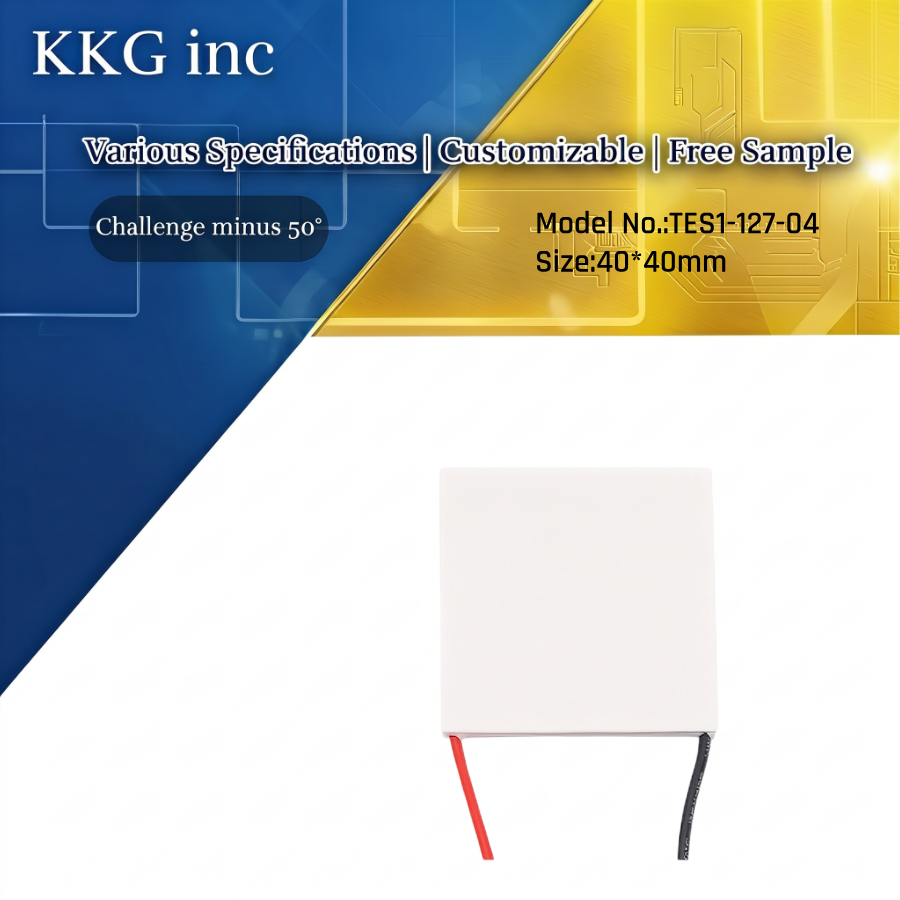
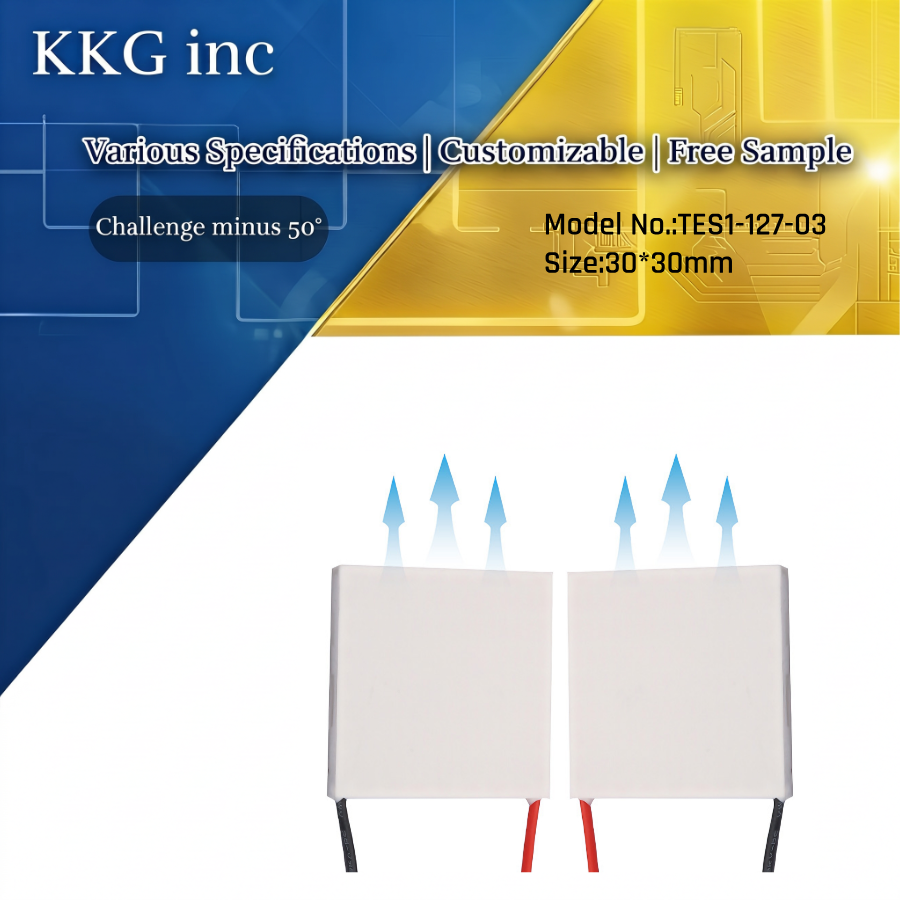
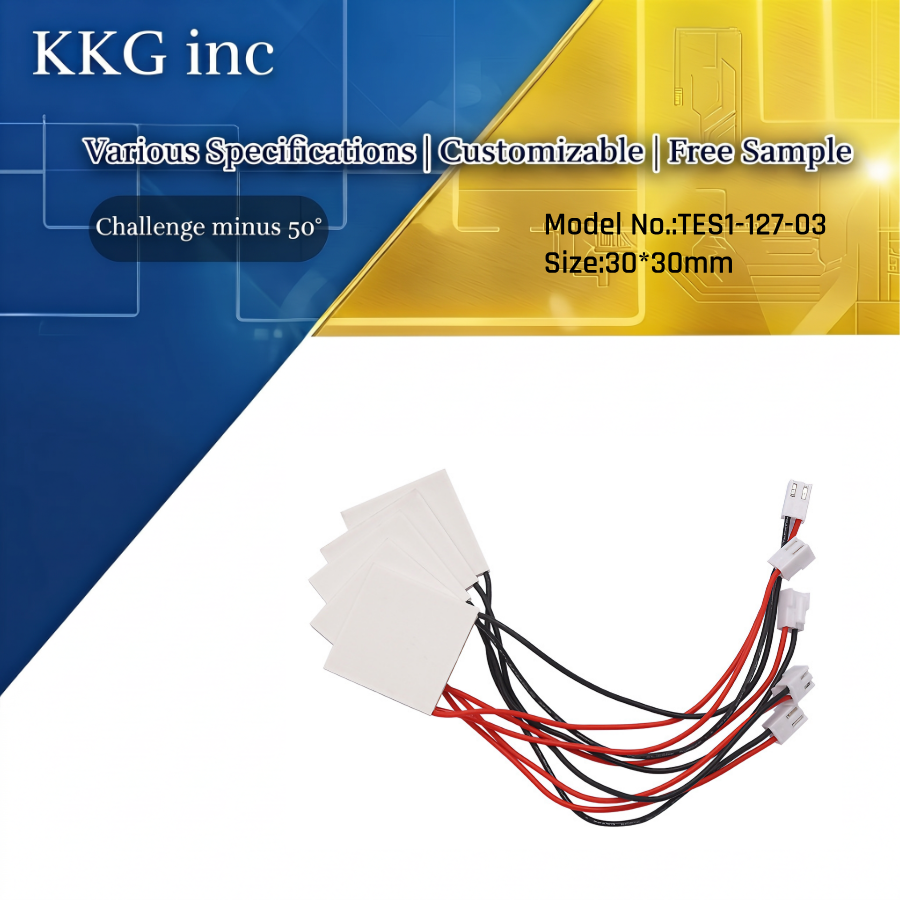
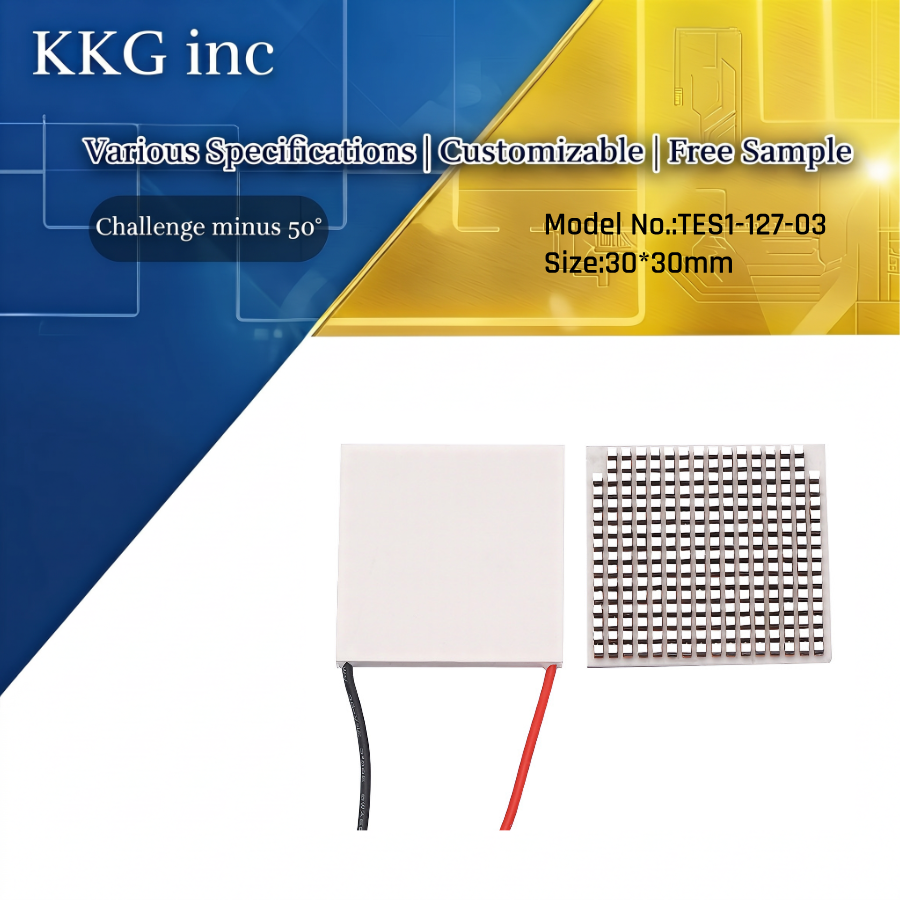
💠Thermoelectric Cooler's Product Drawing
![]()
💠TES1-12703 Peltiers's Product Parameter
| Parameter Item | Details / Specifications |
| Chip Model | TES1-12703 |
| Dimension | 30×30×3.5 mm, 127-couple thermoelectric module |
| Lead Wire Spec | Lead length: 20±8 mm, RV standard wire (Red: positive, Black: negative) |
| Maximum Temperature Difference | ≥65℃ |
| Maximum Operating Current | 3 A |
| Maximum Operating Voltage | 15 V |
| Mounting Pressure | 85 N/cm² |
| Operating Ambient Temperature | -55℃ ~ 83℃ (High ambient temperature will reduce cooling efficiency) |
| Encapsulation Process | Standard 704 silicone rubber sealing |
| Packaging Standard | Foam box packaging |
| Storage Temperature | -40℃ ~ 60℃ (Packaged storage ambient temperature: -10℃ ~ 40℃) |
💠30*30mm TEC Cooler's Model Selection
| Specification | Thermocouple Pairs | L*W (mm) | H (mm) | Umax (V) | Imax (A) | Qcmax (W) |
| TES1-031 | 31 | 30*6 | 2.98±0.1 | 3.5 | 4.1 | 8.67 |
| TES1-031 | 31 | 30*6 | 2.98±0.1 | 3.5 | 2.6 | 5.55 |
| TES1-031 | 31 | 30*6 | 3.25±0.1 | 3.5 | 3.37 | 7.13 |
| TES1-031 | 31 | 30*6 | 3.25±0.1 | 3.5 | 2.16 | 4.56 |
| TES1-031 | 31 | 30*6 | 3.40±0.1 | 3.5 | 3.07 | 6.49 |
| TES1-031 | 31 | 30*6 | 3.53±0.1 | 3.6 | 2.85 | 6.05 |
| TES1-035 | 35 | 30*6 | 2.98±0.1 | 3.98 | 2.62 | 6.26 |
| TES1-035 | 35 | 30*6 | 2.98±0.1 | 3.98 | 4.10 | 9.79 |
| TES1-035 | 35 | 30*6 | 3.25±0.1 | 3.98 | 2.16 | 5.15 |
| TES1-035 | 35 | 30*6 | 3.25±0.1 | 3.98 | 3.30 | 8.05 |
| TES1-035 | 35 | 30*6 | 3.13±0.1 | 3.98 | 3.66 | 8.74 |
| TES1-035 | 35 | 30*6 | 3.53±0.1 | 3.98 | 2.85 | 6.84 |
| TES1-035 | 35 | 30*7 | 2.98±0.1 | 3.98 | 2.62 | 6.26 |
| TES1-035 | 35 | 30*7 | 2.98±0.1 | 3.98 | 4.10 | 9.79 |
| TES1-031 | 31 | 30*8 | 4.32±0.1 | 3.5 | 3.38 | 7.14 |
| TES1-071 | 71 | 30*8 | 2.98±0.1 | 8.08 | 2.27 | 11.03 |
| TES1-120 | 120 | 30*8 | 3.25±0.1 | 13.57 | 1.58 | 12.06 |
| TES1-064 | 64 | 40*8 | 2.98±0.1 | 7.27 | 2.62 | 11.46 |
| TES1-018 | 18 | 10*10 | 3.1±0.1 | 2.04 | 4.46 | 5.34 |
| TES1-018 | 18 | 10*10 | 3.28±0.1 | 2.04 | 4.04 | 4.92 |
| TES1-018 | 18 | 10*10 | 3.46±0.1 | 2.04 | 3.32 | 4.06 |
| TES1-035 | 35 | 12*12 | 3.25±0.1 | 4.2 | 1.28 | 3.14 |
| TES1-035 | 35 | 12*12 | 3.58±0.1 | 4.2 | 1.21 | 2.99 |
| TES1-049 | 49 | 15*15 | 3.19±0.1 | 5.88 | 2.62 | 8.77 |
| TES1-031 | 31 | 15*15 | 3.25±0.1 | 3.72 | 3.37 | 11.2 |
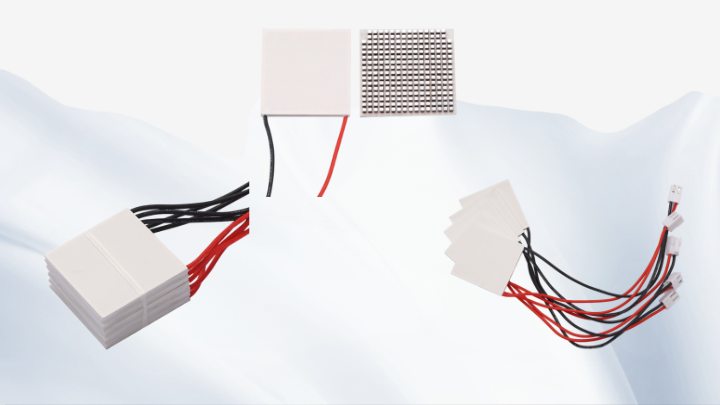
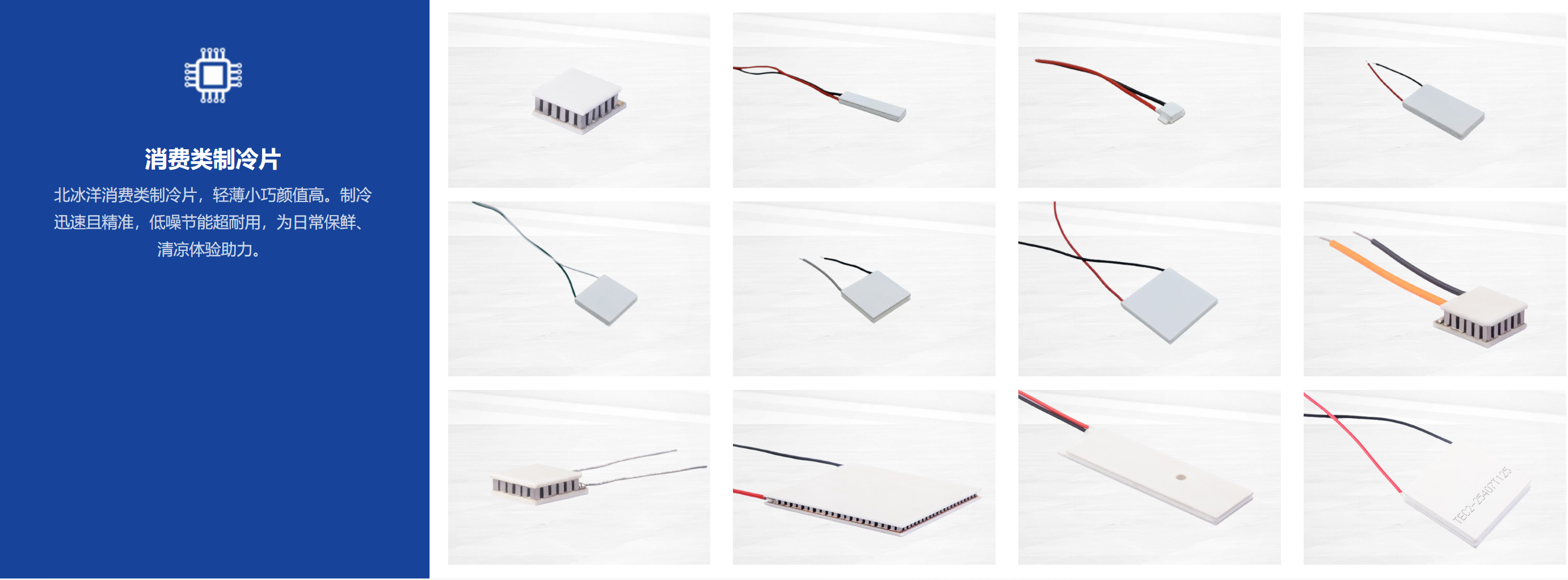
💠Semiconductor Cooler's Product Display
![]()
💠Product Structural Characteristics of TES Peltier Cooler
1. Semiconductor Material: Typically composed of semiconductor materials such as bismuth telluride (Bi₂Te₃), which exhibit excellent thermoelectric properties. These materials generate a pronounced Peltier effect when electrically powered, enabling heat transfer from one end to the other.
2. P-N Junction Array: Composed of multiple P-type and N-type semiconductor particles connected in series or parallel via electrically and thermally conductive substrates (e.g., alumina ceramic substrates). When DC current flows, one end of the P-N junction array absorbs heat (cooling side), while the other end releases heat (heating side).
3. Ceramic Substrate: Serving as the support and conductive connection for semiconductor particles, the ceramic substrate offers excellent insulation, thermal conductivity, and mechanical strength. It ensures stable current transmission while efficiently dissipating heat generated by the semiconductor particles.
4. Electrodes: Metal electrodes are fabricated on the ceramic substrate to connect to external power sources and supply current to the semiconductor particles. Electrode materials typically exhibit excellent conductivity and weldability to ensure reliable connections with external circuits.
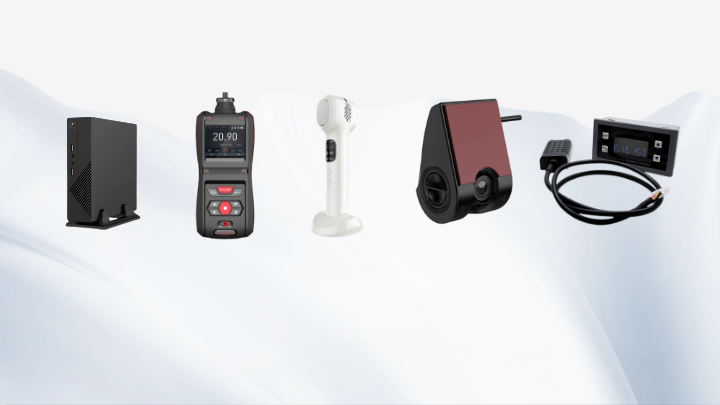
💠The Application of Paltier refrigerator
![]()
The 40×40mm semiconductor thermistor offers an ideal size for diverse applications:
1. Consumer Electronics: Suitable for heat dissipation in compact computing devices like mini PCs, as well as gaming controllers with high-performance chips to enhance comfort and stability.
2. Medical field: Easily integrated into portable diagnostic devices to ensure data accuracy, and suitable for handheld cold-compression beauty devices to achieve portable, precise cooling.
3. Automotive electronics: Provides heat dissipation for in-vehicle cameras to prevent image quality degradation, and regulates temperature in automotive sensors to maintain measurement precision.
4. Industrial applications: Solves heat dissipation issues for small industrial controllers and enables localized temperature control in industrial sensors and actuators.
💠How to determine which semiconductor cooling pad is right for you?
a. Performance Parameters
1. Cooling Capacity: Select a semiconductor thermal pad with appropriate cooling capacity based on actual application requirements. Insufficient cooling may fail to meet demands, while excessive capacity leads to increased costs and energy waste.
2. Operating Voltage and Current: Ensure the selected product's operating voltage and current match existing power systems to prevent malfunction or damage due to mismatched specifications.
3. Temperature Differential Capacity: Understand the product's maximum temperature differential under specific operating conditions, which is critical for applications requiring precise temperature control.
b. Dimensions and Installation: Select a thermoelectric cooling module with dimensions suitable for the application's spatial constraints and installation requirements. Additionally, consider the product's mounting method (e.g., soldering, bolting) to ensure it can be installed conveniently and securely within the equipment.
💠Precautions for Using TEC Cooling Plates
1. Hot/Cold Side Check
▪ Red wire = positive (+), black wire = negative (-).
▪ Power on briefly (≤3 seconds) without heat sink:
▪ Warm side = hot side; cool side = cold side.
⚠️ Do not exceed 3 seconds (risk of burnout).
2. Wiring & Power
▪ Red = positive (cooling), reverse polarity for heating.
▪ Use power supply with ripple < 10%.
3. Voltage Calculation
▪ Model example: TEC1-12706
▪ 127 = thermocouple count; 06 = max current (A).
▪ Limit voltage = count × 0.12 (127×0.12=15.4V).
▪ Working voltage = 78% of limit (15.4×0.78=12.01V).
4. Thermal Recovery
▪ Wait ≥15 minutes for TEC to return to room temperature before reuse.
5. Sealing
▪ Seal edges with 704 silicone or epoxy to prevent moisture and extend life.
6. Installation
▪ Clean TEC, heat sink, cold plate; apply thin thermal grease.
▪ Tighten screws evenly; fill gap with 25–30mm insulation.
7. Pressure
▪ Install pressure: 150–300 PSI (avoid too low/high pressure).
8. Resistance Test
▪ Test resistance with LCR meter/compensated ohmmeter.
▪ Multimeter readings are only for reference.









 Get A Free Quote